
AI Ethical Reflections
Description
Each of our AI Ethical Reflection Worksheets describes an ethically gray scenario of someone using AI as a student, as a professional, or in their personal lives. The worksheet then asks students to answer four questions that guide them to a carefully reasoned decision concerning the moral acceptability of using AI as described in the scenario.
The ethical questions on the worksheets are inspired by four distinct approaches in philosophical ethics: consequentialism, deontology, virtue ethics, and care ethics. Neither instructors nor students need familiarity with these approaches to use our worksheets successfully.
Guidance
We encourage you to adopt a "philosophical" attitude when using these worksheets with your students. The goal is not to tell students whether the situation in the scenario is ethical or not. Nor is the primary goal to decide whether a syllabus policy or professional code of ethics has been violated, though this may figure into students' ethical reflections. The goal is to have students discuss in groups the ethical nuances of the scenario.
In our limited testing so far, we have found that students typically want to say that a scenario is both ethical and unethical. The key follow-up questions are:
Why?
What would we change so it is a clear example of an ethical use of AI?
What would we modify so it is a clear example of an unethical use of AI?
The AI Ethical ReflectionWorksheets
The scenarios in these worksheets cover disciplines in the following very broad areas: Architecture, Agriculture, Business, Engineering, Humanities and Creative Arts, Science, and Mathematics. They are published here as MS-Word .docx files under a Creative Commons License BY-NC-SA 4.0. You are welcome to modify them and share them with attribution. The scenarios themselves were inspired by outputs from an LLM but were edited, and often re-written, by our team.
If you have any questions or feedback about our worksheets, please contact us.
Student Scenarios
S1. Using AI to brainstorm marketing slogans for class
S2. What questions will my professor ask in my presentation?
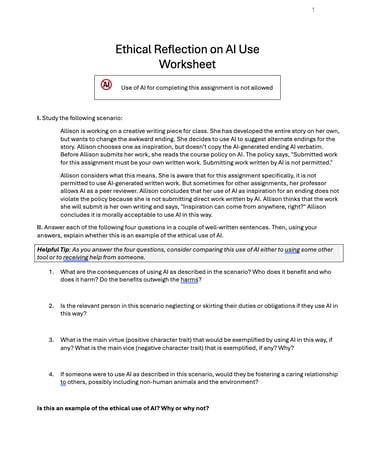
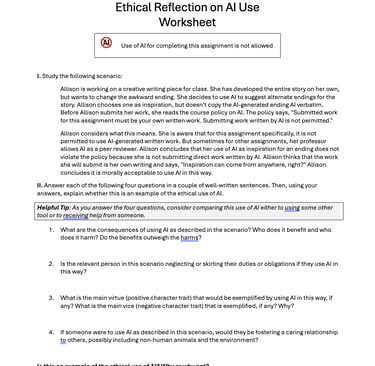
S3. Using AI for inspiration on a creative writing ending
S4. Using AI as a peer editor for my philosophy paper
S5. Using AI to simplify jargon for my class presentation
S6. Using AI to identify sustainable materials for a design assignment
S7. Using AI to generate pseudocode for a homework problem
S8. Using AI to prepare for a chemistry lab
S9. Using AI to strengthen my discussion post argument
S10. Using AI to summarize sources for an annotated bibliography
Professional Scenarios
P1. Using AI to identify safety risks in a prototype
P2. Using company-provided AI to understand legacy code
P3. Using AI to generate client design solutions
P4. Using AI to generate concept sketches at an architecture firm
P5. Using AI to curate design layouts at a creative agency
P6. Using AI to produce financial forecasts for your company
P7. Using AI to evaluate your own interior design work
P8. Using AI price forecasts to advise farmers
Personal Scenarios
Per1. Using AI to comfort a grieving friend
Per2. Using AI to navigate a conflict with a friend
Per3. Using AI to approach a friend about substance use
Per4. Using AI to simulate conversations with a deceased loved one
Per5. Using AI to write empathetic messages to your partner
Per6. Using AI as a confidant when being bullied
Per7. Using AI as a social companion when feeling isolated
Per8. Using AI to interpret a romantic interest's messages
A project funded by:
Chancellor's Office
California State University
AI Educational Innovation Challenge
2025-2026
Critical Thinking and AI Group
California Polytechnic State University
Philosophy Department
F. Fernflores (PI)

